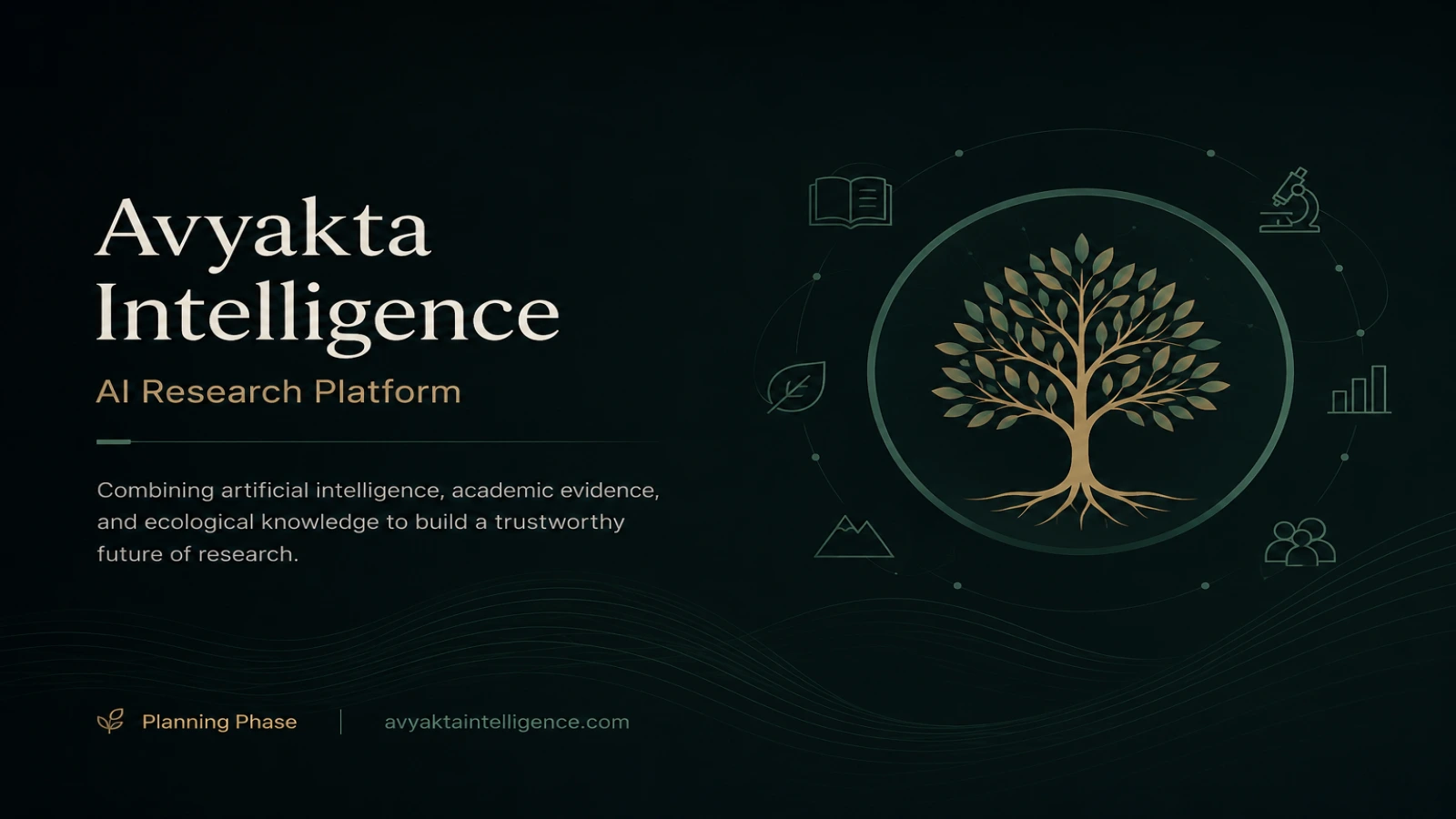
Avyakta Intelligence
AI Research Platform (Planning & System Architecture Phase)
Status: 🚧 Planning & System Architecture
A collaborative research initiative between academia and software engineering.
Project Overview
Avyakta Intelligence is an upcoming AI-assisted research platform currently being designed in collaboration with an Assistant Professor of Botany at Tribhuvan University.
As the Technical Lead, I am responsible for the platform's system architecture, backend engineering, AI integration, and long-term technical roadmap.
Rather than building another conversational AI application, our objective is to create a research platform that responsibly connects artificial intelligence with scientific evidence, expert knowledge, and ecological research.
Development has not yet begun. The project is currently in the architecture and planning phase, where we are defining the vision, evaluating technologies, and designing the MVP before writing production code.
The Problem
Artificial intelligence has dramatically improved how people access information.
However, one important challenge remains largely unsolved.
Local ecological knowledge is rarely represented within modern AI systems.
Across Nepal and many other regions, valuable ecological knowledge exists within:
-
academic field research
-
university publications
-
regional journals
-
local conservation initiatives
-
indigenous communities
-
traditional ecological practices
Much of this knowledge has never been systematically connected with modern AI.
At the same time, AI-generated answers often lack transparent evidence, making it difficult for researchers and students to verify important claims.
Our goal is not simply to generate better answers.
Our goal is to make trustworthy knowledge easier to discover.
The Vision
We believe artificial intelligence should strengthen research—not replace it.
Avyakta Intelligence is being designed around one simple principle:
Preserve local ecological knowledge, connect it with scientific research, and make it accessible through responsible artificial intelligence.
Rather than asking users to trust AI alone, the platform will help them understand:
-
where information comes from
-
why it is trustworthy
-
how it relates to existing scientific research
What Makes This Platform Different?
Most AI platforms focus on generating answers.
Avyakta Intelligence focuses on building trust.
Every major design decision is guided by five principles.
Local Ecological Knowledge
Many generations of ecological understanding remain undocumented by mainstream AI.
The platform aims to responsibly preserve and organize this knowledge while respecting ownership and contributor consent.
Scientific Evidence
Whenever possible, AI-generated responses should be supported by academic literature retrieved from trusted repositories.
Initial exploration includes integration with MIT DSpace and additional scholarly databases in future phases.
Transparent Citations
Users should always be able to understand where important information originated.
Instead of presenting unsupported statements, the platform is designed to display verifiable academic references alongside AI-generated responses.
Expert Collaboration
Artificial intelligence should complement researchers—not replace them.
Academic experts remain central to validating knowledge, improving datasets, and guiding the platform's evolution.
Responsible Knowledge Governance
Knowledge deserves the same care as software.
The platform is being designed with consent, attribution, and responsible stewardship in mind, particularly when working with local ecological knowledge.
Proposed MVP
The first version is intentionally focused.
Planned features include:
-
User authentication
-
AI-assisted research conversations
-
Conversation history
-
MIT DSpace citation integration
-
Automatic reference display
-
Administrative dashboard
-
Prompt management
-
Consent-aware knowledge management
The objective of the MVP is to validate the research workflow before introducing more advanced AI capabilities.
Planned System Architecture
The platform is currently being designed around a modular architecture.
Researcher
      │
      ▼
Avyakta Intelligence
      │
 ├── Authentication
 ├── AI Conversation Layer
 ├── Citation Engine
 ├── Knowledge Repository
 ├── Consent Management
 └── Administration
      │
      ▼
AI Provider + Academic Sources
This approach allows individual components to evolve independently as the platform grows.
Proposed Technology Stack
Backend
-
Laravel 12
-
PHP 8.3
-
MySQL
Frontend
-
Blade
-
Tailwind CSS
-
Alpine.js
Artificial Intelligence
Initially:
-
Claude API
-
OpenAI API
Designed with provider abstraction to support future AI models.
Research Layer
-
MIT DSpace
-
Citation management
-
Knowledge repository
Future phases may include Retrieval-Augmented Generation (RAG), vector databases, and fine-tuned domain-specific AI models.
Development Roadmap
Phase 1
Research Assistant
-
AI conversations
-
Academic citations
-
User accounts
-
Administration
Phase 2
Knowledge Platform
-
Research repository
-
Document management
-
Multi-source academic search
-
Collaboration tools
Phase 3
Research Intelligence
-
Retrieval-Augmented Generation
-
Semantic search
-
Knowledge graph
-
Vector search
Phase 4
Domain-Specific AI
Following sufficient knowledge curation, the platform may evolve toward fine-tuned AI models specialized in ecological and research domains.
My Role
As Technical Lead, I am responsible for:
-
Solution architecture
-
Backend engineering
-
AI integration
-
API design
-
Database architecture
-
Infrastructure planning
-
Security
-
Deployment strategy
-
Long-term technical roadmap
The scientific vision, research direction, and knowledge curation are led by the project's academic collaborator.
Current Progress
The project is currently progressing through:
-
✅ Vision definition
-
✅ Research discussions
-
✅ System architecture
-
✅ Technology evaluation
-
✅ MVP planning
-
⏳ Development starting soon
Looking Ahead
The long-term ambition is not simply to build another AI assistant.
It is to build an intelligent research platform that helps preserve ecological knowledge, connect local expertise with global scientific research, and make trustworthy information more accessible through responsible artificial intelligence.
Beginning in Nepal, the vision is to contribute meaningfully to the broader research community by combining technology, science, and local knowledge in a transparent and ethical way.
Key Takeaways
-
AI should support researchers, not replace them.
-
Local ecological knowledge deserves responsible digital preservation.
-
Scientific evidence should accompany meaningful AI-generated insights.
-
System architecture and governance matter as much as the AI model itself.
-
Thoughtful planning creates a stronger foundation for long-term innovation.
Final Thought
Artificial Intelligence generates answers.
Avyakta Intelligence preserves knowledge, connects evidence, and builds trust.