Airwallex Payment Gateway Integration in Laravel — Building a Secure Real-World Payment System
May 2026 • 5 min read • Birendra Jung Rai
Project Overview
This project focused on integrating the Airwallex payment gateway into a Laravel-based application to enable secure online payments.
While accepting payments may sound straightforward from a user’s perspective, modern payment systems involve multiple layers of communication happening behind the scenes between the client application, payment provider, and backend server.
The primary goal of this integration was to build a payment flow that was:
-
Secure
-
Reliable
-
Production-ready
-
Resistant to fake payment confirmations
-
Easy to scale and maintain
A major part of the project involved implementing secure webhook verification so the application could safely confirm whether a payment event genuinely came from Airwallex servers.
For non-technical readers, you can think of a webhook as a secure notification sent from the payment company to the application server saying:
“The payment was completed successfully — you may now safely update your system.”
The integration was designed to support a complete payment lifecycle:
-
Creating payment intents
-
Redirecting users to Airwallex checkout
-
Handling successful payment events
-
Verifying webhook authenticity using signature validation
-
Updating the client-side database only after trusted confirmation from Airwallex servers
The main challenge of the project was not simply processing payments, but building a secure and reliable webhook verification system that could safely validate requests coming from Airwallex before performing sensitive actions.
The Core Payment Flow
The overall payment workflow was structured carefully to maintain both security and scalability.
1. Payment Request Initialization
The process starts from the frontend payment form.
The client application sends the payment amount and order details to a Laravel controller, which then communicates with the Airwallex API service layer.
The backend creates a payment intent and receives:
-
Payment Intent ID
-
Client Secret / checkout credentials
-
Payment session details
These details are returned as a JSON response and passed into the Airwallex checkout process.
2. Airwallex Checkout Experience
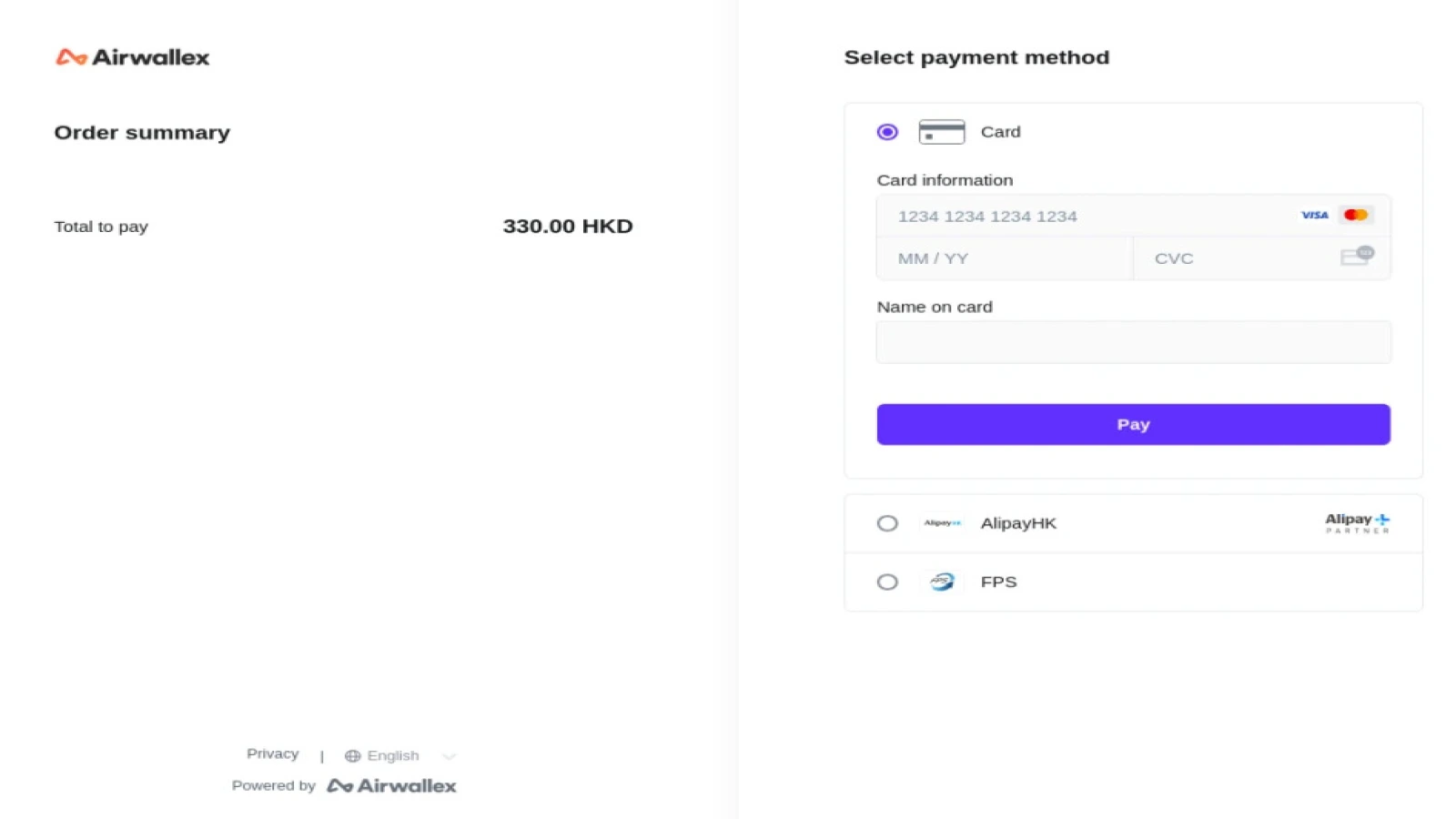
Inside the JavaScript checkout script, the Airwallex SDK is initialized.
From the user’s perspective, this is the stage where they are redirected into the payment interface to complete their transaction using card or other payment methods.
Once initialized, the SDK redirects the user into the Airwallex-hosted checkout flow where the actual payment processing occurs.
At this stage:
-
The payment is handled securely by Airwallex
-
Sensitive card processing stays outside the application server
-
The client application only manages the payment state and callbacks
This architecture improves security and reduces PCI-related concerns.
3. Secure Payment Confirmation Using Webhooks
After a successful payment, Airwallex triggers webhook events to notify the application server.
This became the most important engineering challenge in the entire integration.
The client-side server must verify that the webhook request genuinely originated from Airwallex before trusting the payload.
To achieve this, the webhook controller validates:
-
Webhook signature
-
Secret key
-
Request authenticity
-
Event integrity
Only verified requests are allowed to continue into business logic execution.
Why This Security Step Matters
The database is never updated directly after checkout success on the frontend.
Instead:
-
Airwallex confirms the payment on their server
-
Airwallex sends a webhook event
-
The Laravel server verifies the webhook signature
-
Only after successful verification does the system:
-
Update the database
-
Mark invoices/orders as paid
-
Trigger emails or follow-up actions
-
This prevents fake requests, forged callbacks, frontend manipulation, and accidental database inconsistencies.
In simple terms:
-
A user seeing a “Payment Successful” message on screen is not enough
-
The server must independently verify the payment with Airwallex
-
Only verified server-to-server communication is trusted
Real-World Debugging & Problem Solving
One of the biggest learning experiences during this project was debugging webhook verification.
Initially, the verification system repeatedly failed even though the payment flow looked correct on the surface; also the payment was completed successfully at the airwallex server: and the main issue was our system was not able to get the exact response already returned by the airwallex sever. In order to receive that response from the official airwallex server, the verification needs to be done mandatorily in our side - the main key here is AIRWALLEX_WEBHOOK_SECRET key provided by the airwallex developer account.
The verification flow initially failed repeatedly, and solving the issue required careful end-to-end debugging of:
-
Request headers
-
Signature generation
-
Payload formatting
-
Secret key matching
-
Raw request body handling
The issue was eventually solved by debugging the incoming webhook request from the lowest level possible — inspecting raw headers, signatures, payload formatting, and request authenticity before touching business logic.
This experience reinforced an important backend engineering lesson:
Always debug webhook systems from the raw request level first.
That means developers should first verify the exact request arriving from the payment provider before debugging databases, controllers, or frontend logic.
Even a tiny mismatch in request formatting can break webhook verification.
Once the signature validation logic was correctly implemented, the entire payment flow became stable and production-ready.
Technical Stack
Backend
-
Laravel
-
REST API Integration
-
Airwallex Payment APIs
-
Webhook Event Handling
-
Secure Signature Verification
Frontend
-
JavaScript
-
Airwallex SDK
-
Redirect Checkout Flow
Key Concepts Used
-
Payment Intent Architecture
-
Webhook Security
-
Event-Driven Payment Confirmation
-
Controller-Service Pattern
-
Async Payment Processing
-
Secure API Communication
System Architecture Summary
Simplified Flow
Frontend Payment Form
→ Laravel Controller
→ Airwallex Service Layer
→ Create Payment Intent
→ Return Intent Data
→ Airwallex Checkout SDK
→ Payment Completed
→ Airwallex Webhook Event
→ Laravel Webhook Controller
→ Signature Verification
→ Database Update & Notifications
Final Outcome & Impact
The final integration delivered:
-
Secure payment processing
-
Verified webhook-based transaction confirmation
-
Reliable database synchronization
-
Clean Laravel service architecture
-
Production-ready payment flow
This project significantly improved my understanding of:
-
Real-world payment infrastructure
-
Backend security architecture
-
Asynchronous event handling
-
Webhook authentication
-
Production-grade Laravel workflows
-
Server-to-server communication reliability
Beyond the technical implementation itself, this project provided valuable experience in debugging complex systems where small request-level issues can affect the entire payment pipeline.
Key Takeaway
Building payment systems is not only about accepting money.
The real engineering challenge lies in securely validating events, handling asynchronous workflows, and ensuring that the application trusts only verified server-side communication.
This Airwallex integration was a strong hands-on experience in building secure and production-grade financial workflows using Laravel.